
Tankless electric water heater
blog cate one
casa /

blog cate one

/

Tankless Water Heater Electricity Use: Let's Do the Sums

Tankless Water Heater Electricity Use: Let's Do the Sums

25 Nov 2026

Your water heater does not have a price per month. It has a formula, and every number in it is already in your flat.

Ask how much electricity a tankless water heater uses and you will get two kinds of answer: a vague promise that it saves money, or a number pulled from a different country, a different tariff and a different family. Neither tells you anything about your bill. The arithmetic, however, is short enough to do on the back of an envelope, and it is the only version that survives contact with your own meter.

Anlabeier, the instant electric water heater brand of Zhongshan Chongde Electric Co., Ltd., builds units from 3.5 kW to 12 kW — which is exactly the range over which this sum has to be run.

The Three Numbers You Need

  • Rated power in kW. Printed on the rating plate, on the box, and in the manual. A 3.5 kW unit and an 8.5 kW unit are not the same appliance with a different badge.
  • Minutes of hot water. Not minutes in the bathroom — minutes with water actually flowing. A ten-minute shower with the tap off while you shampoo uses less than five minutes of heating.
  • Your tariff. From your own bill, in whatever currency you pay, including any standing charge if you want the true monthly figure.

Recommendation: write the three numbers on one line before you read another article about savings.

How Much Electricity Does a Tankless Water Heater Use? Run It Once

The conversion is the only bit of physics involved:

kWh = kW × minutes ÷ 60

  • A 3.5 kW unit heating water for 10 minutes: 3.5 × 10 ÷ 60 = 0.58 kWh.
  • An 8.5 kW unit heating water for 10 minutes at full power: 8.5 × 10 ÷ 60 = 1.42 kWh.
  • Multiply by your tariff to get money. If your rate were 0.25 per kWh — a placeholder, not a market figure — those two showers would cost roughly 0.15 and 0.35.

That second line is the one people misread. The 8.5 kW unit is not twice as wasteful; it heats roughly twice as much water per minute. If your shower head and your preferred temperature are identical, the energy needed is set by the litres and the temperature rise, not by the size of the box on the wall. A bigger unit buys speed and simultaneous outlets, not a bigger bill by definition.

Recommendation: treat the kW figure as a ceiling. Your actual draw sits below it whenever the unit modulates down to hold the set temperature.
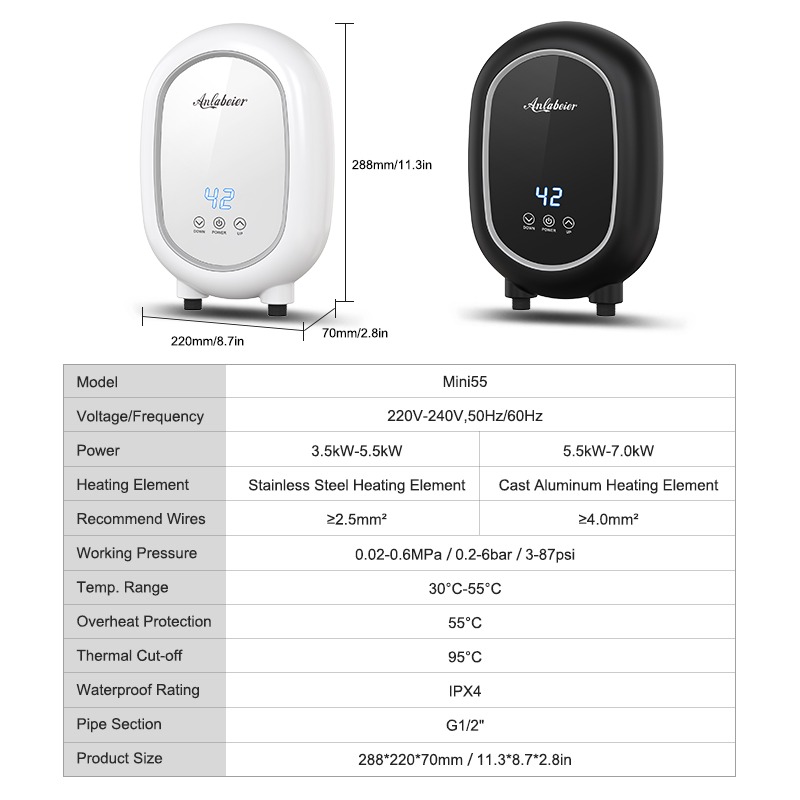
Mini55 instant electric water heater specification: 3.5-5.5 kW and 5.5-7.0 kW models, 220-240V supply, IPX4 rating and two heating element options

Mini55 instant electric water heater — model specification and current listing on our Alibaba.com store.

Why There Is No Standby Loss — and What That Is Worth

  • A storage cylinder keeps a tank of hot water at temperature around the clock, whether anyone is washing or not. That standing loss is real, and it is continuous.
  • A tankless unit heats only while water flows. Between draws it draws nothing for heating.
  • What that is worth depends on how much of the day your cylinder spends reheating water nobody uses: a full house with four showers may barely notice, a one-person flat may notice clearly.
  • Be careful with percentage claims from any supplier, including this one: standing loss varies with tank insulation, size and routine, and is not a fixed slice of your bill.

What Actually Raises the Number

  • Longer showers. Time is a direct multiplier: double the minutes at the same flow, double the kWh.
  • Higher flow. A rain head at 12 litres a minute moves twice the water of a 6-litre head, and water is what you are paying to heat.
  • Colder inlet water. The same shower in January needs a bigger temperature rise than in July, which is why winter complaints are about temperature rather than cost. The seasonal detail is in Tankless Water Heater in Winter: 5 Checks for Cold Days.
  • Scale on the element. A scaled element passes heat less readily, so the unit runs longer for the same result — routine in hard-water areas, and covered in Hard Water and Your Tankless Water Heater: A Descaling Guide.
  • Two outlets at once. Simultaneous demand splits the output and extends the time the unit spends at full power.

Three Ways to Check Your Own Figures

  1. Read the meter twice. Note the reading, live normally for a week, note it again. The difference is your whole household; compare it with a week in which you change one habit.
  2. Measure the flow. Fill a marked container at the shower for fifteen seconds and multiply by four. That gives litres per minute, the input most people guess wrong.
  3. Take the tariff from the bill, not from memory. Standing charges, time-of-use bands and taxes all change the effective rate.

What the Rating Does and Does Not Tell You

  • It tells you the maximum electrical load and therefore the circuit the unit needs: 3.5 kW is roughly 15 A at 230 V, while 12 kW needs a supply most flats do not have.
  • It tells you how many outlets can run at once without the temperature sagging.
  • It does not rank running costs. Two units of the same rating can differ in how well they modulate, how quickly they respond, and how much scale they collect.
  • Choosing between ratings is a separate exercise, set out in What Power Tankless Water Heater Do You Need? A Quick kW Guide.

Why Anlabeier

Anlabeier is the instant electric water heater brand of Zhongshan Chongde Electric Co., Ltd., a manufacturer in Zhongshan, Guangdong that has built instant electric water heaters since 2010. The range runs from 3.5 kW single-outlet units to 12 kW whole-home models, with stainless steel or cast aluminium elements, ELCB leakage protection, dry-heating cutoff, overheat protection and IPX4 casings. Units are tested at incoming inspection, temperature-control, semi-finished, finished-product and packaging stages — which matters here, because stable temperature control is what stops the unit sitting at full power longer than it needs to. The company holds more than 120 patents and works to CE, CB, RoHS, ETL and ISO9001 standards. Models and listings are on our Alibaba.com store: the Mini55 instant electric tankless water heater behind the 3.5 kW example above, and the wider range at zschongde.en.alibaba.com.
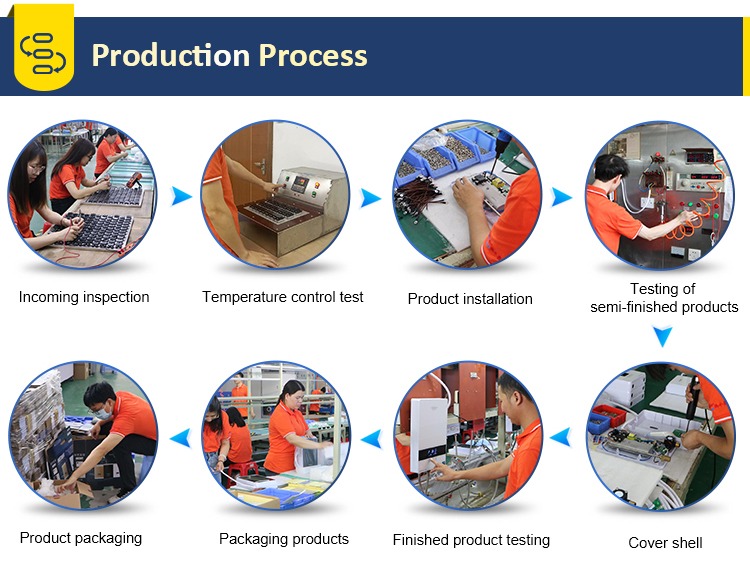
Instant electric water heater production line at Zhongshan Chongde Electric Co., Ltd. (Anlabeier), from incoming inspection and temperature-control testing to finished-product testing and packing

Instant electric water heater production at Zhongshan Chongde Electric Co., Ltd. — see the full range on our Alibaba.com store.

Conclusion

The number you are looking for is not in a brochure; it is 3.5 times ten divided by sixty, multiplied by the rate on your last bill. Do that once and the marketing claims stop being interesting. Anlabeier units from Zhongshan Chongde Electric Co., Ltd. give you the kW figure on the plate; the minutes and the tariff are yours. Every Anlabeier model is specified that way, because the maths is the same at 3.5 kW and at 12 kW.

FAQ

Does a tankless water heater use a lot of electricity?
It uses a lot for a short time, which is a different shape of consumption from a tank. An 8.5 kW unit at full power draws more than a kettle, but only while water flows. Over a month, the total depends on minutes and litres, not on the rating alone.

Is a tankless water heater cheaper to run than a tank?
It can be, where a cylinder spends much of the day keeping water hot for nobody; it may not be in a busy household with a well-insulated cylinder. The comparison is covered in Tankless vs Tank Water Heater: Which One Fits Your Home.

How many kWh is one shower?
Between roughly half a kilowatt-hour and one and a half, for a ten-minute shower, depending on flow rate, inlet temperature and how far the unit modulates. The only reliable figure is the one you calculate from your own flow and tariff.

deja un mensaje deja un mensaje
Servicio en línea las 24 horas, bienvenido a contactarnos para obtener más información en cualquier momento.