
A tankless water heater installation is not one job. It is two — plumbing and electrical. Most homeowners can handle parts of the first. Almost none should attempt the second alone. If you are comparing instant electric water heaters right now, here is what you actually need to know before you buy: which steps are safe to do yourself, which ones need a licensed electrician, and how to plan a tankless water heater installation that passes inspection and keeps working for years.
Short answer: partly. The honest answer depends on what you are installing.
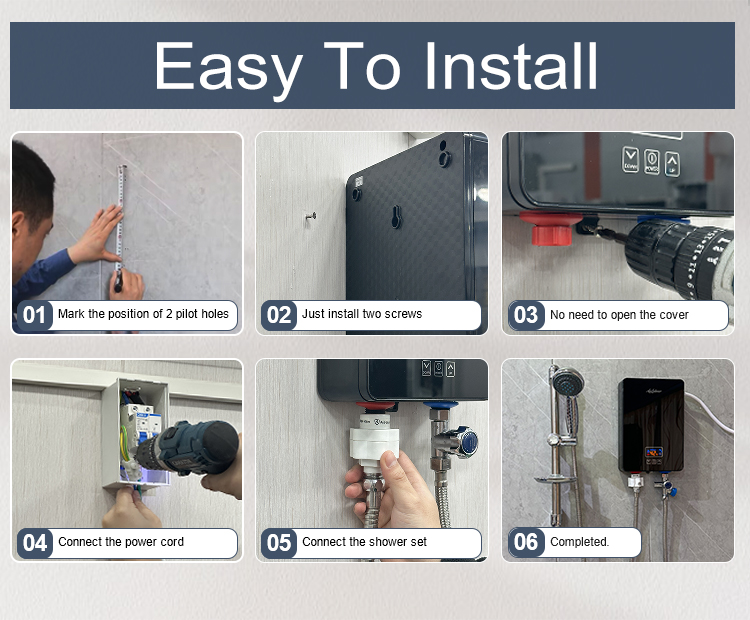
Here is the pattern behind every tankless water heater installation: water-side work is usually DIY-friendly. Electricity-side work is where you stop.
Recommendation: treat it as two separate jobs. Plan the water side yourself — book a licensed electrician for the connection.
Before the electrician arrives, there is real work you can do — and doing it well saves money and time.
Recommendation: do steps 1-4, then hand the checklist to your electrician. It makes their job faster — and their bill smaller.
Electric tankless heaters pull high current for as long as they run. A loose connection or an undersized breaker on a 10 kW-class load is not a minor issue — it is a fire risk. That is why the electrical half of any tankless water heater installation belongs to a professional.
Leave these to the licensed electrician:
Recommendation: if the phrase "breaker panel" shows up in your plan, that is your cue to stop and hire a licensed electrician. Skip this step, and you may void your insurance coverage or fail inspection — savings that disappear fast.
The "right" answer also depends on how much hot water you actually need — because the installation follows the machine.
| Under-sink point-of-use (~3.5 kW) | Whole-home (7-12 kW) | |
| Typical install | Compact, near one sink or bathroom | Central location, serves multiple outlets |
| Electrical work | Often simpler; a dedicated circuit is still usually required | New or upgraded circuit, breaker, wiring |
| Who does it | Possible DIY for water side; electrician for connection | Licensed electrician, non-negotiable |
| Ideal for | A sink, a small bathroom, a rental upgrade | Whole household supply |
If your goal is hot water at one sink or a guest bathroom, a point-of-use unit is the faster, lower-cost route. If you are replacing a tank for an entire household, plan for a full professional install.
Once your unit is in, a simple maintenance routine — a periodic filter check and descale in hard-water areas — keeps it performing for years.
Recommendation: decide on the model first, then plan the install around it — never the other way around.
Anlabeier, the instant electric water heater brand of Zhongshan Chongde Electric Co., Ltd. (est. 2010, based in Zhongshan, Guangdong), builds both ends of this range: compact under-sink units around 3.5 kW and whole-home models up to 12 kW. The brand's heating elements come in stainless steel and cast aluminum — materials chosen to hold up in hard-water areas where bare copper can struggle — backed by ELCB leakage protection, dry-heating cutoff, overheat protection, and IPX4-rated casings. Units carry third-party certifications including CE, CB, CCC, ETL, and RoHS, and the company holds 120+ patents. In practical terms, that means the unit your electrician connects is designed around the safety layers inspectors look for — which is exactly what you want when you are paying for a professional installation.

Tankless water heater installation is two jobs, and the mistake most people make is treating it as one. Do the preparation yourself — location, mounting, water supply. Then let a licensed electrician handle the power side, permits included. Split the work this way, and you get the efficiency and space savings of an instant heater without the risk that comes from guessing at electrical work.
Can I install a tankless water heater myself?
Partially. Mounting and water connections are often DIY-safe, especially for under-sink models. The electrical connection — circuit, breaker, protection — should be done by a licensed electrician in most cases, and some local codes require it.
What does the electrician actually do?
They size and install the circuit and breaker to match the unit's power rating, make the connections, test the residual current protection, and handle permits where required. It is the difference between "plugged in" and "done right."
Is a point-of-use unit easier to install than a whole-home one?
Usually, yes. A compact under-sink model involves simpler electrical work than a whole-home unit, though a dedicated circuit is still typically required. Either way, let the electrician finish the connection.



Scan to wechat


 español
 English
 हिन्दी